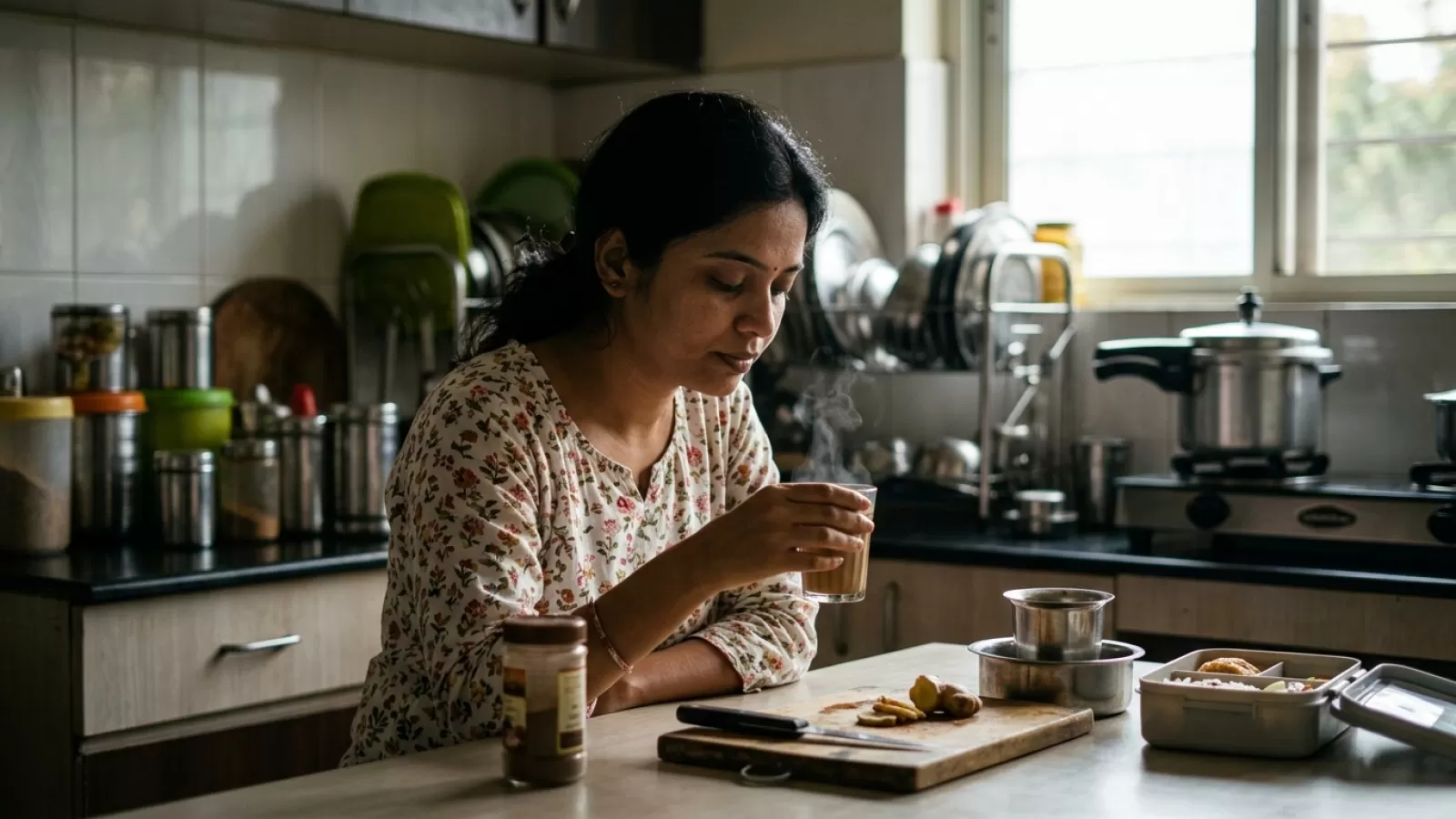
These days, in most Indian households, the day seems to start before anyone is ready. Alarms ring, pressure cookers hiss, WhatsApp messages ping — and before you know it, you’re moving at top speed. The idea of calming pauses in Indian day-to-day life can feel almost imaginary. There’s always a tiffin to pack, a child to wake, a meeting to join, a chapati to flip, or a parent to check on.
Yet, what often slips away is any moment that isn’t about getting somewhere or finishing something. Many adults move from task to task so quickly that even sitting still for five minutes — just breathing, not doing — feels unfamiliar or like a luxury. This constant motion is one of the most common reasons so many people feel worn out, even when the day’s tasks weren’t impossible.
Why Pausing Feels So Hard in Indian Homes
In many Indian homes, the rhythm is set to “fast forward” from the minute people wake up. Morning routines stack up: making chai, preparing tiffin, setting out school uniforms, packing lunch boxes with dal, sabzi, and roti. The pace often picks up when everyone leaves for work or school — and doesn’t slow until bedtime. Even work-from-home setups haven’t made things easier. If anything, the lines between office work, housework, and caring for elders or children have blurred completely.
Most adults in Indian cities and towns are used to the idea that rest comes only at night. Pausing during the day might feel lazy, or even suspicious — especially in joint families or shared homes, where someone is always watching, or might need help. For many, the habit of creating calm moments never developed, because there’s always something urgent waiting. The constant activity is both a source of pride and a pressure that rarely lifts.
What Drives the Relentless Pace
One big reason is cultural: in most Indian families, being busy is seen as being responsible. There’s a certain satisfaction in being the person who can juggle office calls, help with homework, and still make time for a fresh pot of chai. Here’s the catch, though: the expectation that you manage everything — and never complain — means that built-in pauses seem unnecessary or even self-indulgent.
Work demands have changed, too. Commutes in cities like Mumbai or Bengaluru eat up hours. Even at home, the sounds of pressure cookers, fans, and TV blend together, making true quiet rare. Joint families or shared spaces mean that alone time is sometimes impossible. In smaller towns, power cuts or sudden guests add a layer of unpredictability. The tricky part is, many adults don’t see the need for stress relief pauses in India, because the fast pace has become the new normal.
Wellness coaches who work with Indian professionals often find that adults rarely pause unless forced by illness or exhaustion. Many quietly carry the belief that slowing down will make the day spin out of control, or leave someone else with extra work. And even when there’s a tiny window for rest, guilt about not “doing something useful” creeps in.
Clues That Your Day Needs More Pauses
- Restlessness when sitting down: You finally get a moment to yourself, but can’t relax. The mind races through to-do lists, and you feel the urge to check your phone or get up again.
- Snapping at small things: A minor spill, a late phone call, or a missing sock feels like a major crisis. Patience runs thin — especially in the evening, after back-to-back tasks.
- Forgetting small details: Everyday things — like where you kept the house keys, or whether you added salt to the dal — slip your mind more often.
- Physical tension: Tight shoulders, clenched jaws, or headaches that come and go, especially around late afternoon or after long workdays.
- Uneven energy: A rush of activity in the morning, followed by a slump before dinner, and then a second wind late at night when you should be winding down.
Small Ways to Create Calming Pauses in Indian Day-to-Day Life
- Two-Minute Quiet in the Car or Bus: Before entering the house after work, sit quietly for two minutes. Don’t scroll your phone or plan dinner. Just breathe, notice the sound of vehicles or birds, and let your mind settle before the next round of activity.
- Standing Still with Chai: When making your evening chai, stand by the stove and watch the tea boil. Smell the ginger, listen to the bubbling, feel the warmth of the cup. Let it be a sensory pause — not a multi-tasking moment.
- Silent Minutes Before Bed: After everyone has gone to bed, sit with the ceiling fan humming and the lights dim. Notice your breath. Even two or three minutes can help the mind shift gears.
- Window Gazing Break: In the middle of chores, open a window. Look at the sky, trees, or street below. Let your eyes rest on something far, instead of screens or lists. This is a small way of creating calm moments Indian adults can actually fit in.
- Micro-Pauses During Housework: Between flipping rotis or stirring sabzi, set down the spatula for a moment. Roll your shoulders, stretch your fingers, notice the feeling of the floor under your feet.
These aren’t big breaks, and they don’t require special apps or tools. The main point is to do one thing — or nothing — for a minute or two, without feeling that you should be squeezing in another task.
How Calming Pauses Fit Into Real Indian Routines
In many families, the only real pause comes late at night, when the last plate is put away and everyone is finally in their room. But some have quietly discovered other ways. For instance, a working professional commuting in Bengaluru might use the ten-minute auto ride home to close her eyes and listen to her breath, not just music or news. In some joint families, an elder sits by the window every afternoon, sipping dahi or makhana in silence, while the house buzzes around them.
Many Indian adults have learned that the pause doesn’t need to be long or perfect. It just needs to exist. Even when everyone around is busy, one person can step away — even if only for a few breaths — and return feeling a little less wound up. The pause is not about stopping the world; it’s about giving yourself a micro-space within it.
A Kitchen in Nagpur at 6am: A Real-Life Pause
A kitchen in Nagpur at 6am. The air is already warm and heavy. The first whistle of the pressure cooker echoes off the tiled walls. In between chopping onions and checking WhatsApp, someone stands still for a moment, hands resting on the countertop. Through the open window, the faint smell of jasmine drifts in. For 30 seconds, there is nothing to do but watch the early light spill across the kitchen floor. This is a pause — small, almost invisible, but deeply calming.
When a Pause Isn’t Enough: Knowing When to Seek Help
Most of the time, small calming pauses in Indian day-to-day life are enough to take the edge off. But if you find that stress, anxiety, or exhaustion are overwhelming — you’re not sleeping, can’t enjoy things you used to, or feel hopeless even after trying to slow down — it’s a good idea to speak to a doctor or mental health professional. Sometimes, what feels like just busy-ness can be something more.
Common Questions
Finding ways to insert calming pauses in Indian day-to-day life can feel strange at first. A day packed with chores, work, and family needs rarely offers empty spaces — but even the smallest pause can make a real difference. Here are some practical answers to the most common questions from Indian homes about how to slow down Indian daily life, even when there’s barely any time.
How do Indian adults insert genuine pauses into days that seem to leave no room for stopping?
In many Indian homes, adults find tiny pauses by anchoring them to daily routines. One common way is pausing just before switching from one major activity to another — for example, sitting quietly for a minute after finishing kitchen work, before starting office calls. Another is using moments of waiting: while water boils or the microwave runs, instead of reaching for the phone, try just standing and noticing your breath. These micro-pauses, hidden within regular tasks, let you slow down Indian daily life without adding more to your plate.
What are the smallest possible pauses that still provide meaningful stress relief during an Indian working day?
Even 30 seconds of intentional stillness can help. For example, closing your eyes and taking three slow breaths before stepping into a crowded train or starting a Zoom call. Standing by a window for one minute while sipping chai, or sitting quietly at your work desk after sending an email, can also work. The key is to stop all multitasking, even briefly. These stress relief pauses India-style are short, but your mind and body still notice the difference.
Is there a difference between a genuine mental pause and simply switching from one task to another less demanding task?
Yes, there’s a real difference. Just moving from a demanding task (like office work) to a less urgent one (like folding clothes) keeps your mind in “doing” mode. A genuine mental pause means you’re not trying to accomplish anything — just letting your mind rest for a few moments. For Indian adults, these creating calm moments are about not worrying about the next step, even for a minute, instead of just lightening the workload.
How do you convince yourself that pausing for a few minutes will not make you fall further behind in a day that is already full?
This is a common worry, especially in Indian families where being busy is the default. The trick is to remind yourself that a two-minute pause doesn’t derail the day — it often helps your mind reset, so you finish later tasks faster and with less irritation. Many have found that when they add these calming pauses in Indian day-to-day routines, they actually feel less rushed and make fewer mistakes, so there’s less catching up to do.
What time of day is most valuable for an intentional pause in the typical Indian working adult's schedule?
Usually, the most valuable time for a pause is during transitions: between office work and evening chores, or after dinner before bedtime. For many, a short pause right after coming home — before diving into housework — helps separate work stress from family time. Others find that a few calm minutes before everyone wakes up, or just before sleep, is when stress relief pauses India-style have the greatest effect. The exact time varies, but the impact is almost always felt most during these natural breaks in the day.