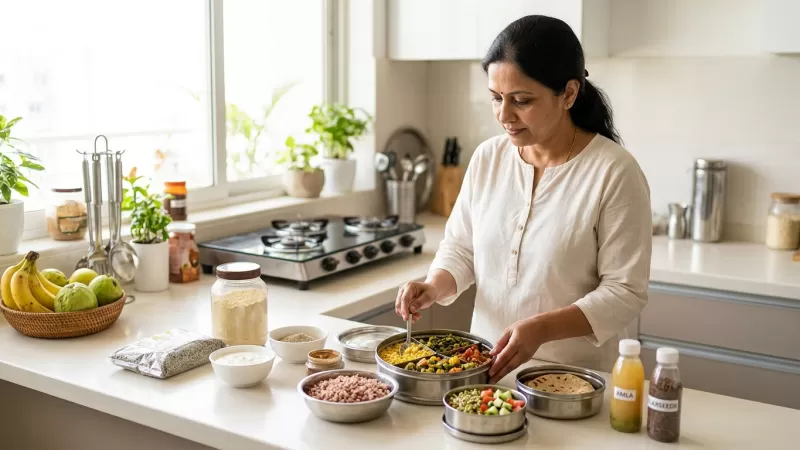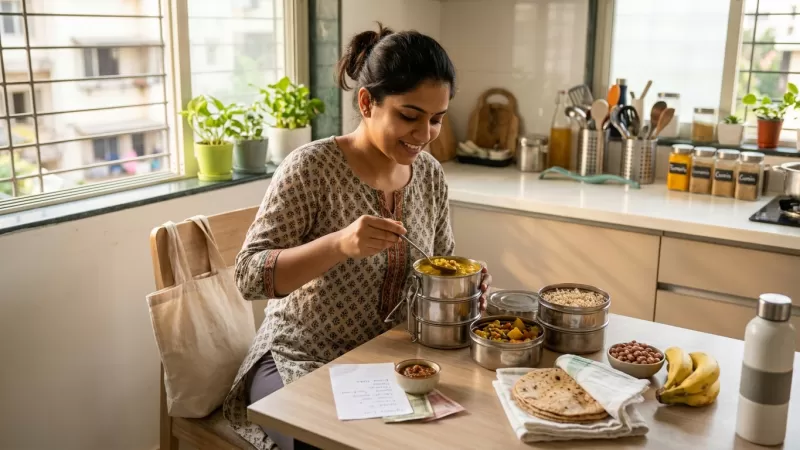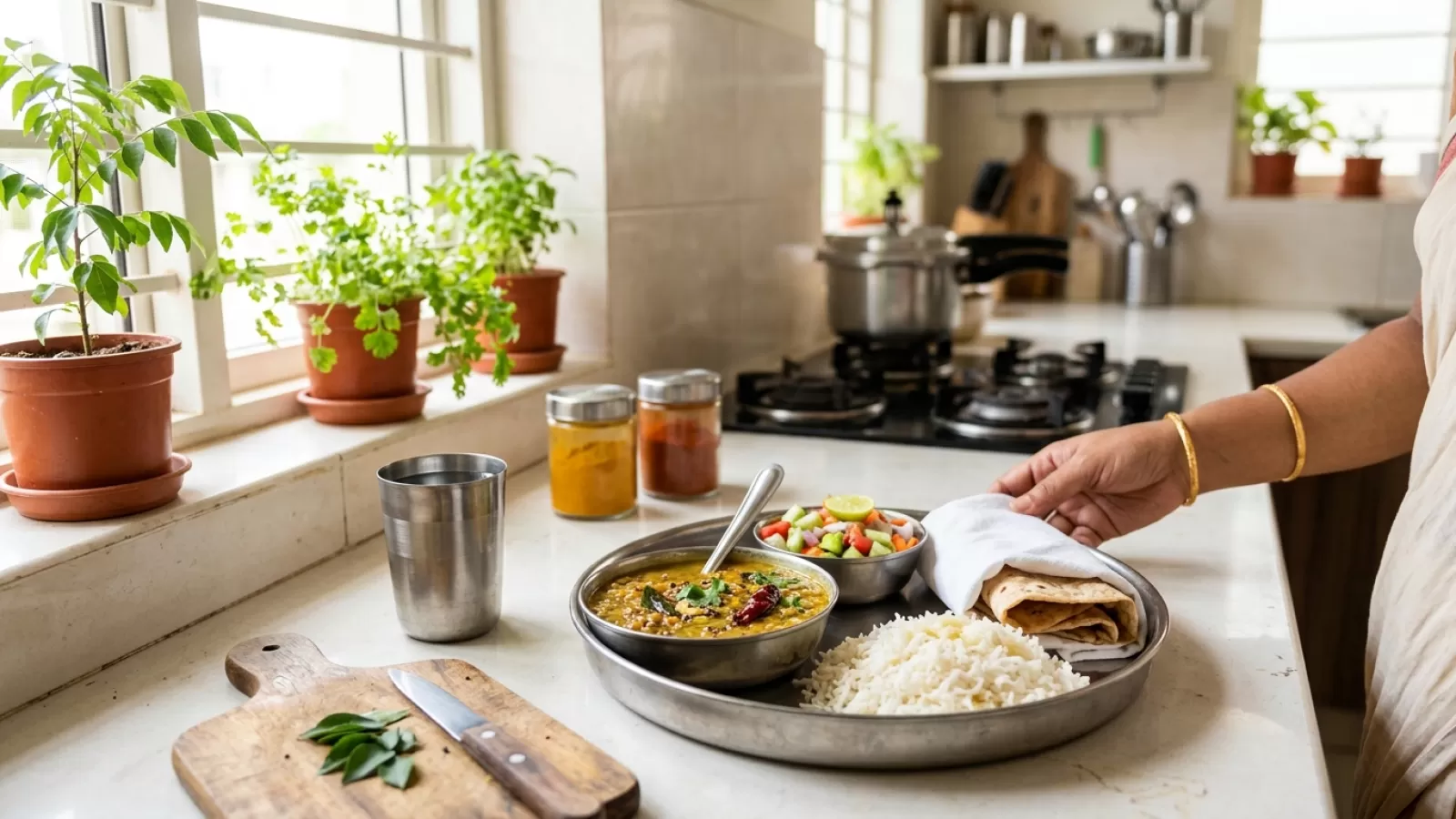
On a late Wednesday evening in many Indian homes, the kitchen clock shows 9:15pm. The school WhatsApp group is still pinging, work emails keep coming, and the only thing that finally gets cooked is plain dal with rice from the pressure cooker, a spoon of ghee, and maybe a cucumber sliced at the dining table. Simple Indian meals for task-heavy weeks are not a sign of laziness or poor planning—they are necessary, practical responses to real pressures most families face, especially when energy and time are stretched thin.
During exhausting stretches like exam weeks or back-to-back office deadlines, low effort Indian cooking becomes the quiet hero. Nobody is making seven-dish thalis, and that’s perfectly fine. Indian food when too overwhelmed to cook often means relying on what is familiar, achievable, and filling—sometimes that’s just roti with dahi and salt, or poha made with whatever is left in the vegetable basket. These are not fallback meals. They are the right answer for those weeks.
When Cooking Feels Like a Chore, Not a Joy
In many homes across India, especially during task-heavy weeks, cooking can quickly shift from a creative act to a heavy burden. The constant balancing act—between office calls, children’s classes, elderly parents’ needs, and the daily chaos—means the kitchen sometimes becomes one more thing on a never-ending to-do list. Most people don’t talk about it openly, but the feeling is widespread.
What often happens is the meal gets stripped down to its basics, and everyone quietly agrees that something—anything—on the table is better than nothing. Sometimes it’s bread with butter and chai at 10pm. Other times it’s khichdi with a side of pickle. The tricky part is, these simple Indian meals during exhausting weeks are not failures—they are the system working as best as it can.
Many families in Indian cities have discovered that the food itself does not have to be elaborate to feel like care. A hot bowl of dal-chawal, or even just curd rice, provides comfort and nourishment during overwhelming weeks.
Why Even the Best-Laid Meal Plans Get Dropped
On paper, meal planning looks like it should solve everything. But in real Indian homes, especially during busy weeks, the smallest disruption—late meetings, power cuts, child’s fever—can throw it all off. The reality is, most people don’t have the luxury of extra help or perfect predictability.
Nutritionists who work with Indian families often find that the biggest barrier to healthy eating is not a lack of knowledge, but the unpredictable demands of daily life. The expectation to produce fresh, varied food every day—even during low energy, high-pressure weeks—is quietly unrealistic. There’s guilt attached to repeating the same meal, or relying on store-bought bread and eggs, but the alternative (skipping meals or eating junk) usually feels worse.
Here is the catch: Indian kitchens are usually well-stocked with staples for a reason. Even when you are too overwhelmed to cook, easy Indian meals during exhausting weeks can be made from just a handful of ingredients—rice, dal, potatoes, onions, and dahi. These foods are the quiet backbone of survival during impossible weeks.
Clues That Cooking Has Become Overwhelming
- Repeated Meals: You find yourself serving the same dal or sabzi for lunch and dinner, sometimes several days in a row. Not because anyone loves it, but because it’s the only thing you can manage.
- Shortcuts Everywhere: Bread and omelette, instant poha, or ready-to-eat pulao packs become mainstays. Even the chutney is skipped.
- Reluctance to Enter the Kitchen: The thought of peeling, chopping, or even washing utensils feels too much. You put off starting dinner until everyone is already hungry.
- More Takeaways or Packaged Foods: There’s a quiet increase in ordering from the local tiffin service or picking up samosas with evening chai.
- Minimal Sides: Instead of three or four dishes, the meal is just one-pot khichdi or curd rice, maybe with a quick salad if someone remembers.
Low-Effort Food Habits That Actually Work
- Lean on One-Pot Wonders: Khichdi, masoor dal with rice, or poha—these are the classic simple Indian meals for task-heavy weeks. They need just one utensil and can stretch to feed everyone, even if someone drops in unannounced.
- Use the Cooker and Microwave: Many homes find that using the pressure cooker for dal or sabzi, and the microwave for reheating leftovers, saves time and mental energy. It’s not fancy, but it does the job.
- Keep Roti Alternatives Ready: When rolling out rotis feels impossible, bread, pav, or even leftover rice can fill in. Bread-omelette is a classic for a reason—fast, filling, and everyone usually eats it without fuss.
- Minimal Chopping, Maximum Comfort: Stick to vegetables that don’t need a lot of prep during these weeks—potatoes, onions, tomatoes. Sliced cucumber or grated carrot can be a salad.
- Accept Repeats Without Guilt: If dal-chawal works for two days, let it. The point is to get through the week, not win an award for variety.
The key is dropping the idea that low effort Indian cooking during busy weeks is something to fix. Often, it is what keeps everyone afloat.
How This Looks in Real Indian Homes
A kitchen in Nagpur at 6am, during the peak of summer. The ceiling fan is barely moving the thick air. One person is packing tiffins for two kids and a spouse, chopping onions directly over the kadai to save time. There is no time for elaborate meals, so today’s dabba is plain jeera rice with boiled eggs and a small container of dahi. Lunch for the elders is leftover sabzi from last night, reheated with an extra spoon of ghee. Everyone eats at different times, but no one complains. The only goal is to get through the day without anyone feeling hungry or irritable.
In joint families, someone might quickly stir together poha or upma using whatever vegetables are left from the weekend market trip. During exam weeks, there’s a silent agreement—whoever is less busy that day takes over the kitchen, and nobody judges the simplicity of the meal. Evenings often end with chai, a few rusks, and the comfort of knowing that food, while simple, was enough.
When Leaning on Others Makes Sense
Some weeks, the only way meal quality survives is by asking for help. In many homes, this means splitting cooking between family members, or quietly relying on a neighbour’s tiffin service for a few days. It might mean accepting that the older child will make Maggi for everyone, or that dinner will just be dahi and leftover rice. Reaching out for support—whether to a family member, domestic help, or a friend—doesn’t mean you are failing. It means you are choosing to survive the week as kindly as possible.
Common Questions
Most Indian homes go through these stretches—sometimes for days at a time—where meals have to be simple just to keep up. If you’re wondering how others manage, or if you’re making the right choices for your family when time and energy run low, you’re not alone. Here are some of the most common questions that come up during these overloaded weeks, answered with real experiences in mind.
What are the genuinely simplest Indian meals to cook when you are completely overwhelmed by the week?
In many households, the go-to simple Indian meals for task-heavy weeks are khichdi (rice and dal cooked together), curd rice, poha, upma, dal-chawal, or just roti with dahi and achar. These meals need very little chopping or attention, and can be made even when your mind is on ten other things. Many families also rely on bread-omelette or a quick sabzi using potatoes or tomatoes. These dishes are quick, filling, and usually accepted by everyone at home without complaint.
Is it nutritionally acceptable to eat the same simple Indian meal multiple times during a particularly demanding week?
During overwhelming weeks, repeating the same meal—like dal-chawal or khichdi—several times is common and usually fine for most people. In joint families, it’s not unusual for lunch and dinner to be the same, especially when everyone is busy. Adding a side of dahi, a fruit, or a bit of salad helps round things out. If anyone at home has special dietary needs, it’s worth checking in with a doctor, but for most, simple repeated meals during busy stretches work just fine.
How do Indian families maintain meal quality during the busiest weeks without the primary cook feeling they are failing?
Many families quietly shift expectations during task-heavy weeks. Instead of aiming for variety, they focus on putting something nourishing on the table. Low effort Indian cooking during busy weeks often means everyone accepts simpler meals and helps out where they can, even if it’s just setting the table or washing utensils. There’s usually an unspoken understanding that survival comes first—extra help, less variety, and using up leftovers are all part of the plan. The sense of failure fades when you see everyone fed and less stressed.
What Indian pantry staples always allow a proper if simple meal with minimum effort and decision-making?
Most Indian kitchens keep rice, dal (moong, masoor, or toor), potatoes, onions, tomatoes, dahi, basic spices (jeera, haldi, salt), and atta. With these, you can make khichdi, dal-chawal, potato sabzi, poha, or even just rice with dahi and achar. These staples remove the daily stress of decision-making and make easy Indian meals during exhausting weeks possible, even when you’re too tired to think about what to cook.
How do you get through a genuinely impossible week in India without nutrition completely collapsing but without adding meal planning to the already full list?
During impossible weeks, Indian families often fall back on routines that require the least thought—rotating between khichdi, poha, roti and dahi, or ready-to-eat mixes. Many set a loose pattern: maybe dal-chawal twice, poha for breakfast, bread-omelette one night. Accepting help, using leftovers, and dropping the idea of perfect meals are quiet survival tactics. The goal is to get everyone fed, not to create variety or balance every nutrient perfectly for a few days. That’s usually enough until things settle down again.